Saturday, August 19, 2006

Session 14: Rye for the first time - a good location

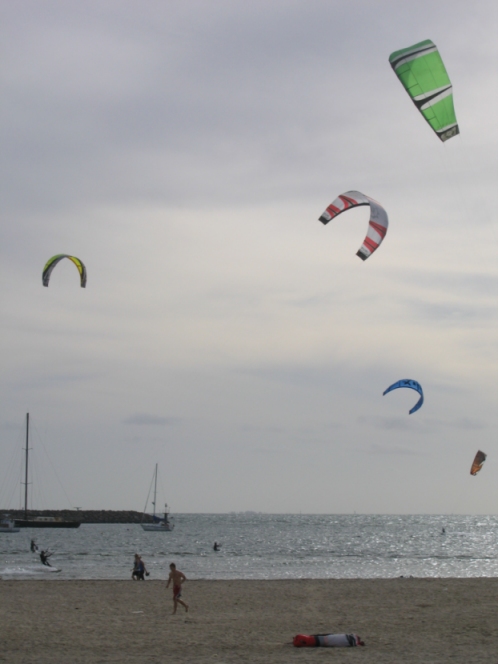
I need to visit Sorrento on the Mornington Penninsula to help my brother Donald move some furniture, so I took my kite along. The Bay winds website showed a good Northerly, which suits Rye. I got there at 11:30, three others were out a and having a good time in 18 knot winds.

It is a nice site. Not too crowded (at this time of year anyway) and no obstacles to contend with.

Launching was easy with some help. My first run was not too good, I basically tea bagged.

Then I had a couple of great fast runs out and back up wind. Not too much chop either.

A light plane flew right over me - so low I wondered whether I should drop my kite!

The weather was fine and sunny. The water was cool, but my 3mm steamer wetsuit kept me quite warm.

The wind was a bit gusty, with holes in it. It dropped to 15 knots and changed from a Northerly (one of the few sites in Melbourne for this direction) to a North Westerly. A Westerly here would be off shore.

I played around with my kites "Centreline Adjustment Strap" (CAS). The Cabrina manual says the black ball is for depower and the red one for power, but mine is the other way around - presumably an assembly mistake. Pulling the blackball takes tension off the front lines and hence puts more pull on the back lines - which generates more power. It is a fiddly adjustment to make. I will check out the new Cabrinha Crossbow bar when they arrive in Australia, and maybe get one with a 7m kite.

What I practiced:
  • Leaning back. This helps carve the edge of the board to go better upwind.
  • Diving the kite more agressively to start and then plane to get going. I have been tending to "drag sideways" when attempting to get going.
  • Using the sine wave for the kite - keep the kite moving up and down, but not going too high.

Wednesday, August 16, 2006

Session 12: Kitesurfing at Port Douglas

Lena, Chloe and I went to Port Douglas in July for a holiday and to visit our friends Doug and Wendy who now live and work there. Doug took the kitesurfing shots.

I am glad I took my kitesurfing gear - the kitesurfing was sensational. The south end of 4 Mile Beach is the place to go, at Helmet St. There is a small coconut palm shelter where Brett Wright operates the Windswell Kite Surfing School. Brett was a great source of local information.


The beach is wide and good for launching. There is a reef just to the South which protects the water from chop. A Southerly was blowing at 15-20 knots - the Winter trade winds. I wore my 1mm wetsuit as it was overcast and not very warm. On the tack out (to my right) I was having some trouble generating enough power - the board would stall. Coming back in (to my left), I was going really well with heaps of speed.

I went out and back about 4 to 5 times, then walked back along the beach. Eventually, I got going better to the right as I stopped the kite going to the edge of the wind window by not oversheeting the control bar.


Great to be kitesurfing again. It has been too long between outings.

Tuesday, February 21, 2006

Session 11. Out and back - definately a moment

Wind 18 to 20 knots, Southerly
Fine but not hot.
Back at Hampton beach

Got to the beach at about 4:45. Twisted two of the lines while rigging "across the kite'. Another kiter said its better to rig with the lines directly out in front - which avoids confusion and crossed lines.

I used my bouyancy vest for the first time - it felt quite good and did not impede my movement.

I got up and running to the left (my 'strong side') and was able to really get moving with good control. The key is to back the power off by pushing out the bar if you are getting overpowered. I could focus both on flying the kite - which I was able to keep fairly low - and on steering the board with my rear (right ) foot. The board was carving fairly well and I was alble to really zip along, which was a great experience.

Coming back (to the right) was OK too. I was able to get up and planing, but not as consistently. But then it clicked and I was able to make some good ground.

On my second run I got yanked off my board on startup but was able to kite drag back towards it, swim to it and grab it, then relaunch my kite without too much trouble. I did a couple of shorter runs out and back, then walked some distance back along the beach.

Then the moment - I did a longish run out and a then came back to where I started! A great feeling. Things are really coming together.

The key seems to be flying the kite in the right spot, keeping the speed up, and steering the board. I was able to briefly "lock the kite in" on a few occasions for the first time.

Then I did a huge run out - thinking it was time to consolidate my learnings. Cut through some biggish waves, then I headed back in. I was so far out I was not able to easily spot which rock groyne I had started near. As I came back in I was able to sneak past the last groyne with good control and get back very close to the start point.

I then did a couple of more out and backs.

Well, this really confirmed kiteboarding as a superlative experience for me. So much power, so much freedom, so much speed.


It is much nicer at this beach. Just a few kiters - some self launching and self landing. I self landed and had a little trouble getting the kite to flip leading edge down but perservered and succeeded.

Sunday, February 05, 2006

Session 10. A new venue and renewed confidence

Wind about 21 knots
Fine and sunny

My first outing at Hampton Beach. It is nowhere near as crowded as St Kilda, although there were several kiteboarders about. I was able to inflate the kite on the grass at the top of the small hill next to the beach then take it down. Parking is also easier.

In the water I felt under control, and was able to get partially up and going to the left, then head back in to the right. My focus was on maintaining control and "throttling the power". I was able to get up and going to the left fairly well. The tack took me towards a rock groine, which I was mindful of. It would not be good to get dragged into it. So I headed back in before I went past it and did the "walk of shame" back up the beach.

The other kiters here keep well out of the way - they turn around when they come close rather than "sneaking past" as they do at St Kilda. This is a lot better for learning as it removes the additional worry about other kiters and crossed lines and potential collisions etc.

I was able to fly the kite well, but had some difficultly "locking it in" at a fixed height during my attempts to go upwind. The kite seems to want to adopt the sine-wave pattern.

I landed the kite solo by bringing it down to the beach, then yanking on the front lines to get it to tip leading edge down onto the beach.

Summary
A confidence boosting session, and a much better venue. I felt more in control and comfortable with the kite.

Saturday, January 21, 2006

New lines fitted

Friday 20 January 2006

I visited SHQ and got some replacement lines. They did not have the exact Crossbow replacement lines, but they did have 25m Cabrinha lines of equal length but different colour coding. However, they were about 5cm shorter than the existing lines, so I bought a complete new set (for about $200) and have kept the original two front lines as spares.

Ivan (of SHQ) fitted the lines outside the shop, which involved changing the attachment method for the front lines. We got rid of the "quick release" fitting that nobody uses and simplified the attachment. Then the lines were fine tuned for length.

Both rear lines are equal length - test with all for lines under tension and the bar being even. The rear lines are slightly shorter than the front lines.

Check the front lines for equal length by holding the together then stepping forward - both should sag evenly.

Thursday, January 19, 2006

Session 9. Aborted with a snapped line

January 18 2006

Back to St Kilda for another solo session.

I was feeling a bit dubious after the encounter with the other kite at the last session.

I rigged up and joined the queue of beginners learning.

When attempting to get going, the right rear line snapped, resulting in the kite crashing not too heavily into the water. Upon examining the lines, they had been damaged during the line-crossing incident at the last session. I didn't pick this up when I was running the lines out during rigging, but there were several spots in both rear lines where there were serious wear points.

I was lucky the line did not snap when I was out from shore.

So I packed up and went home.

Summary

Always check your lines when rigging the kite. If you have any accident or incident involvling the lines, check them very carefully.

I visited SHQ and got some replacement lines. They did not have the exact Crossbow replacement lines, but they did have 25m Cabrinha lines of equal length but different colour coding. However, they were about 5cm shorter than the existing lines, so I bought a complete new set (for about $200) and have kept the original two front lines as spares.

Ivan (of SHQ) fitted the lines outside the shop, which involved changing the attachment method for the front lines. We got rid of the "quick release" fitting that nobody uses and simplified the attachment. Then the lines were fine tuned for length.

Both rear lines are equal length - test with all for lines under tension and the bar being even. The rear lines are slightly shorter than the front lines.

Check the front lines for equal length by holding the together then stepping forward - both should sag evenly.

Saturday, January 14, 2006

Session 8 – Windy conditions and colliding kites!

13 January 06

Wind 20 knots – Southerly
Weather fine
4pm start, not too crowded.
Stopped about 5:45pm.
Helmet on.
Tried seat harness for the first time


I thought that the wind might be a little bit too strong but decided to have another go “at the upper margin”. The wind seemed a bit stronger than Session 7.

No problems launching!

Tentative about getting up. Headed left half in the water. When carving starts, again get a lot of pull and started slide slipping. Solution is to fly the kite more into the wind? I tried that.

Getting going is touchy: too much power and you get hoiked off your feet – this happened a couple of times. The board hit my wrist (small bruise) and my left foot (small bruise).

Then I did a a run out left where I felt in control and was preparing to go back when another kiter collided his kite lines with mine resulting in immediate mayhem. The other rider said he would try to “surf through” my lines – which of course did not work. Both kites were tangled together and both of us getting dragged. He eventually let go of his bar which resulted in his kite pulling free from mine. I body dragged in with my board. His rig was tangled, but he seemed in good spirits.

When conditions are “full” you are not the only one who may have trouble. Others were ditching their kites and flailing. But many were whizzing along apparently at ease with the conditions, dialing in as much or little power as they need.

I got lifted once about 1m; quite a good sensation and under control.

The seat harness was definitely more comfortable, but a bit harder to walk in due to the straps under the legs. No riding up though.

NOTE: The tendency to pull on the bar is a real trap for beginners. You need to focus on backing off the power by pushing the bar away if you are getting over powered. This is a bit counter intuitive. Flying the kite into the wind window is not the only way to reduce power.

Friday, January 06, 2006

Session 7 – Up and going, making progress

5 January 2006

Wind 20 knots – Southerly
Weather fine
5pm start, fairly crowded.
Stopped about 7pm. Helmet on.

I thought that the wind might be a little bit too strong but decided to have a go “at the upper margin”. My 12m Cabrinha Crossbow is rated to maximum windspeed of about 21 knots.

I rigged up with a crossed line so I had to re rig.

Progress
  • I gotup and going to the left well. Up and running, but still going too fast. Corrected by edging board and heading more upwind.
  • One big crash when I was not sure about a kiter coming towards me and distracted. The kite inverted and twisted, so I “sailed to shore”, let some pressure out of the leading edge bladder, walked back and re-rigged.
  • More successful left tacks with a controlled stop.
  • Less successful on right tack – still not getting enough power and staying too far upwind. Then I got some more power, followed by board heading a bit more downwind. This did the trick as I got up and running for a short time. Basically, I had one very successful “out and back run”.
  • I was worried about losing board, particularly as I am now getting out quite a way. So I tend to let the kite land, swim to the board, then relaunch the kite. However, this increases the risk of the kite inverting and not being able to relaunch, and is also a hazard for other kiters. Better to body drag back to the board?

Summary

What a blast, I am really getting going now and my confidence is building.

One other kiter recommended putting name on board (& “reward”) NOT using a leash. He has had his returned twice after losing it during Winter.

The waist harness still riding high on wetsuit, so I will get a seat harness.

Session 6 – Up and going but a lot of speed and some crashes

5 January 2006

I visiting the training beach at St Kilda with about 20-25 kph winds blowing. I sam my friend Geoff Butcher (also learning kiteboarding) there.

I felt a bit rusty getting going. Then I got up and heading left for some distance.

Heading back in (right) was still more difficult, but I got in one good run (the first one heading right).

Observations:

  • Once up, forgetting about the kite and concentrating too much on the board, so the kite crashes out.
  • I sometimes ran out of power and sank back in (too much to the side of the wind window?)
  • The kite sometimes scooted back to the right when I was heading left – need to focus on keeping in left quadrant when going left.
  • I again sometimes gathering too much speed again and planing – eventually the board skittered out.
  • Kite “jelly fished” – upside down and back to front (?). Very difficult to water relaunch. When I eventually did the rear and front lines were crossed on each site. Kite could still fly, but this was not ideal. I landed it and re-rigged.
  • I headed quite a way out, then crashed and the harness became unhooked. Holding the bar just put the power on (no depower via harness pulling on front lines) so I let go of the kite. It then blew along the beach faster than I could swim after it. Another kiter helped out by going and jumping on it. I swam to shore (quite a way) then ran along the beach to get it. Lines tangled, kite OK. Carried the kite back along the beach.
  • Not enough air in leading edge bladder – go “very firm”
Summary

Overall, a challenging session. Making some progress, but also encountering hurdles. Losing the kite is a real hassle, and relaunching it is not always easy.

I noticed some people use retractable board leashes. This is NOT recommended as the leash can yank the board towards you, which can then collide with you. If you use a leash, you MUST use a helmet to be safe.

Thursday, December 22, 2005

Session 5 – My first solo and some success

21 December 2005

My first solo session.

I visiting the training beach with about 15-20 kph winds blowing.

I had some difficulty getting enough power to start. Then I got too much power and into the air (2-3 meters), but I kept hold of the bar and came down with a splash, kite still flying.

Stood up and started heading left, with board edged and kite flying! What a blast. I decided to head back in before I got too far out.

Heading to the right was not so easy. I could not get properly out of the water and basically “board dragged” back in. I crashed kite and water launched it. I also lost the board, which a sail boarder brought back to me. Then I lost board, swam to it.

Summary

Kiteboarding it is not too easy to learn, but is a sensational experience when you get going.

Wednesday, November 23, 2005

Lesson 4– Standing up

22 November 2005

This lesson was focused on standing up - to initiate a run on the board.

Steps

  • Assume position as for Lesson 3 (in water, kite 12:00, board on feet)
  • With kite overhead, dive it into power zone
  • Heading to your left: as the power comes on and pulls you up out of the water, point the board in the direction of the wind
When out of the water and planing:
  • push the rear of the board around with your right foot
  • lean back against the power of the kite
  • angle the lower edge of the board into the water
To head the other way:

  • Reverse this procedure to heading in the opposite direction left
  • If you get up and sailing, concentrate on where you are heading and where you are flying the kite.

Trap: If you stay planing, your speed increases and the board skitters around, making it difficult to control, like being on a rocket sled.

Tip: Edge the board

Trap: It is usually easy to go one way, but more difficult to go the other way. This is mainly due to flying the kite too far upwind on your “weaker” side so it does not generate enough power:

Tip: Bring the kite above head and dive into power zone to start

Summary

  • I got out of water OK
  • I was planing very fast and wipeout several times
  • I flew the kite too high after starting; then lost power and sank back into water
  • Controlling the kite becomes more difficult due to distractions with board
  • Flying kite to high – waist harness riding up and hurting ribs a bit. This also affects how you can operate the control bar. A seat harness would be better for beginners.

Tuesday, November 22, 2005

Lesson 3– Board on and drag

21 November 2005

This technique is similar to body dragging, but with board on feet and keeping board downwind.

  • Walk into water and lean back into water
  • Fly the kite directly above head
  • Fit board to feet by feel – keep watching kite at 12:00
  • Make sure board is oriented correctly (top of board is up)
  • Fly the kite right and left, counteracting the pressure with feet. When kite goes to the left, put pressure on left foot. When kite goes to right, put pressure on right foot.
  • Continue with this until can maintain position of board downwind, always with pressure on feet.
Summary

This technique get you used to controlling the board and balancing the power of the kite against foot pressure on the board. It is a prelude to standing up.

Tuesday, November 01, 2005

Lesson 2 – Body dragging

31 October 2005

  • 5m Kite already set up
  • Walked into the water
  • Start flying 8s and get dragged face first
  • Keep 8s tight. Most power near water
  • In lower winds, don’t turn too sharp (lose power)
  • Fly kite at 12:00 (lofted) when walking back
  • Got lifted high with one gust – heaps of power, even though wind was not strong
  • Walk backwards & pull bar down to keep kite flying

Summary

Got to feel the real power of a kite. This technique is used for self rescue and getting back to your board if you lose it in a wipe out.

Friday, October 28, 2005

Lesson 1 - flying the kite

27 October 2005

These are notes from my first kiteboarding less with Matt at St Kilda, near where the old Beaconsfield Hotel is - a very popular spot with local kiteboarders. After several booking cancellations due to unfavourable weather conditions, I finally have a lesson.

I have been flying a 2.1m 4 line trainer kite for over a year as preparation.

Briefing

  • Wind window
  • Power zone
  • Use figure 8s in half of wind window in direction of travel
  • Kite generates pull when turning – use this in lighter winds
Setup

  • Inflating kite – blow tubes to very firm and seal with Velcro
  • Put kite leading edge down, top to wind. Put sand onto wing either side of central bladder to keep it there.
  • Can walk with kite by holding onto leading edge in middle
Rigging the kite

  • Left side of bar – lines and thread stitching on lines are colour coded
  • TRAP: incorrectly rigged kite is uncontrollable – can be dragged
Launching

  • From edge of wind window to 12:00 – don’t launch directly or too much power generated.
  • Walk with kite in edge of wind window, holding top of bar and adjusting to keep flying – can walk into wind.
Flying
  • Used a 3m kite
  • Clipped into harness
  • Sitting & getting dragged through the sand
  • Lots of power
  • Flew figure eights – keep them tight
  • Use arms to steer, but harness to take weight of kite (not the bar)
  • Bar clip a bit tricky
Summary

It was great fun flying a bigger kite. Looking forward to the next lesson.