Tuesday, February 12, 2008

Session 33: Jumping!

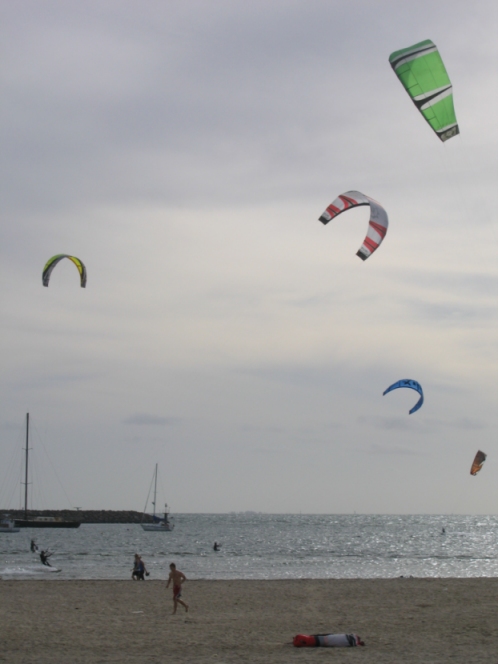
Hampton beach at about 20 knots was on again at about 5pm today (Tue 12/2/08) after a couple of out and backs to get going I tried some jumps. This time I succeeded. Initially I was carried in the air for about 3 - 4 meters just off the water.


It definately helps when you get airborne first off a wave, then fly the kite back to vertical and pull the power on. It was a bit daunting to do this right out from shore as a wipeout and tangled kite would mean probably a half hour swim in, so I kept my jumping moves closer to the shore.

I got one really good jump in (probably not very high, but it felt fantastic) when I launched off a wave and swung the kite back to vertical quickly with the power on. The touch down was not too rough, but it is easy to lose the board. Ivan advised me afterwards to turn both feet out in the loops to lock them into the board when in the air.

I augured in on one fast return leg chasing a speedy windsurfer and nearly stopped another kiter coming towards me in his tracks. He jumped over my horizontal lines though without too much trouble, then I retrieved my board and got going again.

I took my GPS out again and logged 29.4km for this session. I didn't reset the maximum speed though. Here is the track log.

I was out for about 1.5 hours. There were about 10 to 15 other kiters out too.


Saturday, February 02, 2008

Session 32: Good wind and some jumping practice

Got on the water at Hampton Beach just after 5 pm with a good wind blowing at around 20 knots. Cranked a lot of speed leaning right out and carving upwind with the power on.

There were about 15 kites out. I did a reach out past the Middle Brighton headland and enjoyed the view. Not a good place to ditch the kite or lose your board though. It would be a hell of a swim in.

There is something really cool about having that kite flying and boosting you across the water.

I kept the power on going over a few large waves and was plucked airborne for a short distance which was a great feeling.

I also tried a couple of edge releases and was lifted just off the water too. Jumping is much harder than it looks. There is some real skill involved in setting up the jump and executing it, which surprises me as I thought all you had to do was "send the kite back" and up you went.

I lost my board a couple of times augering into waves. Upwind body dragging is not hugely successful, so I let the kite touch the water at the edge of the wind window and swam some strokes to get the board. Relaunching the kite from this position was easy. I also saw another kitesurfer swimming back for his board with his kite parked directly overhead, which is better than landing it on the water.

Tired after about 1.5 hours so I came in and landed the kite on the near empty beach and headed home.

Kitesurfer in Geraldton WA rescues father and two sons

Here is a remarkable story of kiteboarder Matty Kalajzich's brave rescue of a father swept offshore holding on to two kids who couldn't swim at Geraldton in 30 knot winds.

In an act of great bravery, Matt used his kite to body drag one of the kids to shore, then the Dad and remaining child.


Source: Kitesurfer saves drowning family, via Seabreeze.com.au

Sunday, January 20, 2008

Session 31: Another great day at Hampton

With a good southerly forecast for the day and blowing late in the morning, I headed to Hampton beach and got on the water at about 11am. The wind was consistent and in the range 20 to 25 knots, so conditions were really good.

After a goofy launch when I downed the kite I was up and going hard. Good speed and upwind tacks. The tightened footstraps were an improvement. I kited for about an hour then came in for a rest.

The wind kept on blowing and more kiters arrived and got going too, but it wasn't too crowded. I headed out for another session. I got hoiked off my board when doing a turn and couldn't really get back up wind to retrieve it, so I came in to shore waited for my board to wash in. A lapse of concentration saw me dive the kite into the beach too - yuk. Luckily there was no damage, they really are quite tough.

After untangling the lines I did a finals session getting upwind to the breakwater to get some real speed on the flatter water then came back downwind slalom to the beach. I tried a few more jumps without much success. I think I am starting with the kite too low. It is harder than it looks. I did get a little bit of air though.

I am finding "toe down riding" a bit disconcerting too so I intend to practice it some more.

Ivan showed up with his "surf style" board and departed to do a downwinder from Ricketts Point back to Hampton Beach, which he said would take about 2 hours.

I dropped my kite into SHQ to get the bridle lines checked for wear. After a couple of years use they may well need to be replaced.

I will try out a surf style board as they seem have advantages in a biggish swell and on light wind days.


Wednesday, January 16, 2008

Session 30: Fast upwind at 25 knots

The wind stayed less than 20 knots most of the day, but then picked up above 20 at 4pm, so it was time to have another go. It was blowing fairly hard at Hampton Beach and quite a few kites were out enjoying the wind.

I was on the water at about 6pm and immediately going places. Good wind makes it easier to kitesurf, as long as you keep control.

I used my shorter Litewave Tsunami board, but the straps were adjusted wide so I could use wetsuit booties during winter. Consequently, I was having a little trouble keeping my feet in the loops. I hit a wave crest and had the board plucked off my feet. I retrieved it by upwind body draggging, which was tricky in the strong wind. You need to keep power in the kite flying low above the water and really work the keel with you free hand, which is quite tiring.

Locking the kite in and going upwind was no problem in the 25 knot wind. No real danger of the board stalling. Some gusts tend to soak up most of the depower of the kite though.

Going out in the big swell was fun. The swell near the offshore reefs marked by buoys really stands up.

Turns were going well. With so much power in the wind I could almost stall and then get going again.

I got upwind as far as the breakwater, hoping to get some flat water behind it. However, at the flat water you lose the wind, so I did some wakeboard slaloms to go downwind.

I tried jumping for the first time by edging the board and sending the kite back to 90 degrees. I succeeded in getting lifted a bit, but not a lot. It seems I have developed some "anti lofting reflexes" which I will have to unlearn in order to get bigger air.

Lost my board again while cranking turns, but another kiter brought it over to me, which was most appreciated.

I finished after 7pm, feeling pumped. One of the best days ever.

I met Rick and Oz at Hampton - both had a great day out too. Ivan and the boys for SHQ were out kiting with their surfboards too.

Now I will tighten up my footstraps.


Friday, January 11, 2008

Session 29: Ripping at Hampton

A strong wind forecast of 30 knots came through at about 1pm, breaking the recent three day opressive heatwave of 40 degrees plus. I got down to Hampton at about 3pm. The wind was strong but perhaps not 30. I elected to give the 7m kite a go in case the wind picked up or big gusts came through.

I got up and going, but the kite was a bit underpowered. Also, it flys so fast compared to the 12m kite. I had to fly it to generate more power and also go downwind a bit. Great to get going though. Unfortunately I dunked the kite a coulple of times, then couldn't relaunch it off Brighton.

Speaking to Ivan from SHQ, he advises putting in as much pressure as the pump will allow to make sure the leading edge keeps its shape.

Another drift in to the beach. This time I tried he self rescue techique and wound one of the rear leaders around the bar and eventually got to the kite. I managed to get through some keen surfers in the swell at the beach, but then found alarmingly that I had heaps of line wrapped around my right ankle! The amazing thing was there were so many loops it was like I had attempted to do this. I thought about cutting the lines, but the kite was under control with me holding he tip and I was able to secure it on the beach immediately.

I then set about dealing with huge tangle - which took me about half an hour to resolve. Back at the car, the wind was still strong so I took out the 12m kite. Finally, some good wind! Great to get some speed up, go upwind and get some turns happening in the swell. Interestingly, the wind was 20 knots but a Southerly, which seemed to be easier to get out from behind the breakwater.

No dunkings, no swimming and some slowish turns. I tried the "one hand technique" briefly but found that I wanted to keep both hands on the bar to allow up and down direction for the kite. I was contemplating trying some small jumps - or at least board edging - but was a bit hesitant.

I would have finished at about 7:30pm, very happy and pumped.

It was sensational to feel the power of the wind and the kite and really lean against it. I think the larger board helped in the chop too.

Thursday, January 10, 2008

Session 28: A downwinder in light wind at Hampton

Very keen to get out so I headed for Hampton with the wind speed showing around 15 knots in the afternoon and the forecast saying it could reach 20 knots. It was a very hot day so I wore board shorts and a rashvest rather than my 1mm wetsuit.

I rigged up and had a go but I struggled for wind again. The Crossbow 12m kite is rated for this wind strength but I struggle to go upwind and 15 knots. Maybe I am a bit too heavy at 82kg?

The wind didn't pickup above 15 knots, but it was so good to get the kite flying and into the water I elected to do a downwinder to Brighton which went quite well. I was again frustrated to see others whizzing along upwind off Hampton - maybe on bigger kites, or just with better technique.

Coming into the beach I picked a spot with some sand and not too many bathers. However, there was a nasty little reef exactly where I floated in on my back with my kite still flying. When I stood up my leg went right into a "rock hole" and I grazed my shin. If you were not careful or were unlucky you could even break your leg at ths spot.

I walked the kite back inflated, but struggled a bit to get past the first main groyne. Deflate next time, it is not worth the hassle.

Friday, January 04, 2008

Holidays at Sorrento, strong winds but sideshore

With the new year just arrived we headed down to Sorrento, Victoria for a short family beach holiday. I took the kite gear hoping for some wind.

Last year there was virtually no wind so I left my 7m kite behind. Space in our Suburu Liberty wagon was at a premium with baby gear for our daughter Chloe, the sea kayak and fishing gear on board too. It was a mistake to only take the 12m kite - heaps of wind this year and the 7m kite could have been used.

I saw a couple of kiters out in the strong Easterly, I think they launch at Sullivans Bay just east of the Sorrento sailing club. They were heading way out to the North and looked expert. They would need to be. If you dunked your kite and had to "float in" it would be a long way to the shore and you would be blown onto cliffs, boats and possibly the Sorrento pier!

Wind map for Thursday 3 Jan


View Larger Map

Sullivans Bay

There was only one other kiter out off Blairgowrie. However, the wind was basically sideshore, the beach was crowded and I thought the wind was a bit too strong for the 12m kite. Nobody was kiting at Rye. Frustrating . . .

Tuesday, January 01, 2008

Session 27: Desperately seeking wind

I injured my shoulder skiing in September and was forced to rest from kitesurfing until late December. I have been really hanging out for some wind and to get back out.

Finally, I was able to get down to Hampton on New Year's day with favourable conditions.

Fawkner Beacon wind graph - 1 January 2008

However, although the wind was reasonable out past the breakwater, there was a lull behind it on the beach. I launched the kite but couldn't really get going. Eventually near the rock groyne I started to get it together but there was another kite pfaffing around where I was headed so I turned around. Dunking the kite I drifted into shore and was assisted by another kiter who grabbed the kite.

There were heaps of kites on the beach and quite a few on the water. It seems like Hampton is getting more crowded. Quite a few people sunbathing and swimming too.

Frustrating. It seem that sheeting the kite in too much in an effort to get power sends you upwind and you lose too much power. I was on my small board too - which is harder to get going in lighter wind.

Saw some snazzy beach launches and many new kites. The Switchblade 12m kite is reputed to have as much power as the 2006 16m kite, and less bar pressure. I am holding off buying a bigger or newer kite for now.

Tuesday, July 24, 2007

Session 26: Rye in winter with good wind


Kitesurfing at Rye, Arthurs Seat in the background.


After a prolonged period with no kitesurfing, it was great to get onto the water. A northerly was blowing at around 20 knots down at Rye so I took my kite down on a family trip to the Mornington Peninsula.

The water was cool but not cold. I stayed warm in my 3mm steamer.

I tried out my new short board - a Litewave Tsunami. It went upwind really well and turns much better than my older Cabrinha board. However, my feet with wetsuit booties would not fit through the foot straps well, so I ended up using my surf socks and putting up with cold feet. I think I need to fit some wider straps over winter to accomodate the booties, then swap back to the narrow straps for summer.

The wind was nearly on shore so the runs were close to the beach. The new board edged well but was a bit harder to stay up on. Heel turn jibs seemed much easier. The board is really easy to flick around and quite a stable platform.

Here is the wind map - quite consistent wind for winter.

And some photos of Georges who was also having a great time.


Rye pier in the background

Good air with Rye pier in the background

Saturday, July 07, 2007

An inspiring video of kiteboarding in Egypt

This is my favourite kitesurfing short video. The location is somewhere in Egypt. Great moves, fast turns, heaps of speed, big air and an excellent location with flat water and strong winds. Enjoy.


YouTube link

Wednesday, June 27, 2007

Back in Port Douglas waiting for some wind

I am in Port Douglas again for some warm water kitesurfing. However, the weather is abnormal for this time year (climate change effects?) as there is very little wind and quite a bit of rain at times.

I was up at Cooktown for 2 days last weekend and the wind was howling in at Quarantine Bay. It was blowing consistently at about 25-30 knots day and night.

Back at Port Douglas, no wind though! I did some revision on the beach with Brett who detailed a means of self rescue by:
  • Pulling in one rear line at least a kitespan (about 4 metres)
  • Winding a few turns of line around the bar to lock it off
  • Then wind the rest of the lines together along the bar (as per normal) until you get to the kite
  • Hang on to the kite
  • Make a sail by grabbing both ends of the kite and bringing them together
The wind picked up at 12 noon today and I scooted down to the beach only to see the wind stop. It only blew for 1 hour which was rather frustrating.

I found a small cut through the sail fabric which needs a repair though. I stuck on a patch and am now sorting out a more permanent fix.

Hopefully I can do an outer reef kiting trip. This is where the above "rescue technique" is essential for getting back into the boat without lines becoming too twisted.

Friday, April 06, 2007

Melbourne kitesurfing locations map

I have just created a map of Melbourne kitesurfing locations using Google's new "My Maps" feature. I have entered some information about spots on the East and the South of Port Phillip Bay. You may find it useful.

Thursday, March 15, 2007

An update on the kitesurfing gear I am using

This an update on the gear I am currently using, including a few tips.


I have worn these "surf socks" the last few outings. They do reduce the feel of the board a bit, but they were great to have on when I got washed up into the rockwall and reef after not being able to relaunch my kite. They also provide protection from glass and other sharp items. This is not a major problem at Hampton Beach, but people have got some nasty cuts at St Kilda.


I wear this 1mm steamer which I bought a few years ago for diving in the tropics. I find I don't get too hot and it keeps the sun off. So far, I haven't got too cold either, but I don't think it would be warm enough for winter. I notice many people kite in boardshorts and rash vests, but I like having the thin layer of neoprene for protection.


I have taken out this Garmin Forerunner 101 GPS (minus the wrist strap) in the waterproof pouch. It is interesting to get the speed readout and track log. The unit got water in the battery compartment when I wore it on my wrist, so I now keep it in the pouch in the front pocket of my vest. So far I haven't carried out a phone in a waterproof pouch.


I wear this Gath helmet over the top of Ocean eyewear polarised sunglasses, which also have a firm retaining strap. The helmet stops the glasses coming off. I notice most people don't use a helmet, but I think the additional safety is good, especially while learning. Most fatalities in kitesurfing result from head injuries, so a helmet protect against this. So far (touch wood) I haven't conked my head on anything yet. The glasses are excellent for reducing glare.


This is a bouyancy vest I bought from a caneoing shop. It has a pocket on the front that I put my keys and GPS in. The padding provides some additional protection and it obviously means I float better. I plan to take out a slim waterproof camera soon in the front pocket too, or perhaps strapped to my wrist.


I have cut out additional toe grooves in both footpads (on the right of the picture) so I can get a better grip on the board to stop my foot "shaking out" of the straps at speed. This works well, but is less effective with the surf socks on. They tend to jam a bit tighter under the straps and also have a grip surface though.

Also note I have written my name and phone number on the board in the event I lose it in an out-to-sea epic and it gets washed up. Another kiter said his was returned after he lost it in Winter once.


This is the Dakine seat harness I am using, with an additional donkey dick on the bar (which I don't use now). I attach the safety leash below the bar so if I pull the safety the kite goes free. There is a pocket for a safety knife for cutting the kite lines in an emergency on the back of the harness.


This shows the leg loops of the seat harness - very handy for stopping the harness climbing around your ribs when the kite is above you while learning. The safety knife is in the middle. I haven't tried the waist harness since using the seat harness. It may be a bit more comfortable, so I will give it another go soon.

The kites I have are still the 12m Crossbow (15 to 25 knots) and a 7m Crossbow (30+ knots), so far with no modifications other than simplifying the line rigging for the 12m bar.

Monday, March 12, 2007

Session 24: 20 knots on Labor day holiday

A good consistent Southerly during the afternoon on Labor day holiday was a great opportunity for another outing. I was on the water at about 2 and the conditions were good. Lot of speed and not too much swell. On the water, I was pondering on how surreal kitesurfing is. Just, you, the board, the wind and the water. So much power, so much speed and so much fun.

By contrast, the politicians on the news this morning are talking about building another coal-fired power station in Victoria. If you can crank out 30km/h on a kiteboard, surely we can generate our power from a mix of wind and solar?

The turning is progressing well - I am concentrating in keeping power in the kite and getting a slight downwind run to gather speed.

I met Rick, another kitesurfer on the beach who has been reading this blog. It was nice to hear someone is getting some benefits from it.

Please feel free to leave comments on blog postings, or use the email link on the right hand panel to contact me if you wish. I am interested in your feedback.


GPS readings
  • Max speed:28.1 km/h
  • Trip odometer: 8.05km
  • Average: 8.7 km/h
  • Time: 0:55
This is a track log from the GPS, but the map calibration is not quite right yet. As you can see I did one longish run to peek down towards Brighton, and the rest of the time doing short runs to practise turns.


Yesterday the wind was blowing at 30+ knots. We made a family trip to Elwood and walked to St Kilda, where we watched a couple of kiteboarders jumping close to the pier. Spectacular air, 4m+, but no impact vests or helmets. I took some photos and will put them up in a separate posting.

Sunday, March 11, 2007

Big wind day and jumping at St Kilda

On Sunday 1 1 March, we did a family trip down to St Kilda for a walk along the foreshore and to check out the kiting action. I didn't take my kite. The wind was blowing at 30+ knots. We weren't dissappointed with the action - a couple of guys were doing outrageous jumps right next to the pier in sheltered water, but with the wind raging overhead.

There were sSome serious obstacles about - like the dredge moored nearby, and no helmets or impact vests. Apparently there has been one kiting fatality with impacting the pier while jumping, but today everything was fine.

They made it look easy - edge the board in to build up pressure then release the edge and fly the kite high. Once in the air, the kites were flying around and coming low again. Landing on the heel pointing downwind seems like the go. Really impressive stuff.


This is looking from the St Kilda pier back to the main kiting area just to the West.

Big air next to the pier, with the dredge in the foreground

Ditto

Getting some speed heading towards the pier.


The wind chart for the day

Monday, March 05, 2007

Session 23: Good wind, turning and my GPS onboard

A good strong consistent Southerly started blowing in the early afternoon so I headed home early and got to Hampton Beach at about 3:30 and was on the water by 4. There was a reasonable chop/swell, and the wind seemed a lot stronger than my last outing. I took it easy intially keeping upwind, but relaxed a bit and went for more speed.

The wind chart showed 20knots gusting to 25. What a difference 5 knots makes!

I had a great outing. Looking down at the board and watching it carve the water. No problems keeping upwind. Catching the swell coming back in and surfing over waves with lots of speed. Consistent turns are very satisfying. I gently dunked the kite a couple of times while practicing turning but relaunched it without trouble. It is a bit hard getting the board downwind when you are get body dragged. I hoiked on the bar to generate lift above to bring the board under me once.

This was a memorable outing on the water for about 1.5 hours. I felt tired and satisfied afterwards.

I think I am nearly ready to try some small jumps soon.

Turning tips

I successfully turned both left and right on several occasions. Some things I did that helped me:
  • Don't let the kite get too high while changing directions or it loses all pull and you stop in the water
  • Keep some power in the kite as it pulls you downwind in the middle of the turn
  • When you steer in the new direction, the kite wants to dive and will hit the water if you are not careful. Watch it, and bring it up to prevent this.
  • Get some power on as quickly as possible to get going again
GPS log

My GPS worked well in the waterproof pouch. The stats were:
  • Max speed: 37.9 km/h
  • Trip odo: 17.6km
  • Log start: 4:10pm
  • Log finish: 5:32pm
I am working on overlaying the track log on a map, but I need a lower scale digital map.

Wind chart

Thursday, March 01, 2007

Session 22: A downwinder to Brighton

The wind chart was good in the afternoon so I to go kitesurfing rather than bike racing. A Grade at Sandown has been very tough lately. I got to Hampton at about 5:30 and was on the water at 6:00 after untangling my lines. I tried my newly purchased battery operation Coleman pump for the first time. It is handy for filling the main bladder while pumping up the strut bladders manually. I think the new single fill bladders (like on my 7m Crossbow) make life easier too.

The wind seemed a bit low. I got going out OK (to the left), but couldn't keep the board speed up consistently coming back (to the right). Some others were managing better - perhaps they had bigger kites or better technique.

The Fawkner Beacon wind chart indicated about 18 to 15 knots but it did not seem that strong at Hampton and Brighton.

I decided to do a downwinder to Brighton rather than just flail about or go home. It was a good trip. I picked up a few good gusts and ended up sticking my nose around the point at Brighton near the railway station. I landed on the beach behind some bemused bathers then deflated my kite and walked the 1.5km back to my car.

Lighter winds are good for perfecting technique (or realising you don't have any), and downwinders are fun.

Wednesday, February 21, 2007

Session 21: Ripping in a good breeze then another drift in

The sea breeze picked up during the afternoon with me stuck at work watching the bay winds chart. I left the office at 4:45 and caught the train home. Hot and oppressive humidity so a quick trip to Hampton beach was attractive even though it was getting late.

I was on the water about 6:30, in a bit of a rush. The leading edge bladder was a bit soft but I thought I would manage OK - wrong!

Up and going with speed in the 20 knot southerley. I used my new Garmin Foretrex 101 GPS today for the first time to track my speed and course. Maximum speed was 43.0 knots, which felt that fast too. I found some water in the battery compartment when I got home, despite it being rated waterproof, but luckily I was able to quickly wash and dry it and get it going with fresh batteries.

Turning to the left is going well, but not to the right. I continued past the rock groynes then plopped in the water. On getting going my kite hit the water. When relauching it the leading edge collapsed (not enough pressure!!) then the kite jellyfished. I couldn't relaunch the kite despite pulling on rear lines and the front lines repeatedly. It was a tangle blob. I got blown in past the rock groynes (good) I ended up drifting to the sea wall short of the beach, with the 1m bay surf breaking against it (not good).

Yuk. I popped the safety and swam in to retrieve and secure the kite before it got pulverised. Luckily I was wearing "surf socks" so I was able to walk over the rocks without too much hassle. Then I retrieved kite lines and the board, deflated the kite and walked back to the car.

Here is my track log. You can see the drift in.


Lessons learned today:
  • ALWAYS put good pressure in the bladders, especially the leading edge (main) bladder
  • Do not be in too much of a hurry to check equipment, make sure you have enough time to enjoy yourself and avoid an epic
  • Don't trust electrical equipment that is supposed to be waterproof, put it in a protective case as well!
  • Watch where you turn while learning. If you stuff up the take off and tangle the kite where will you drift in to? Beach is good. Rocks, groyne, seawall or pier is not good.

Saturday, February 03, 2007

Session 20: Hampton beach in 20 knots - the best day so far

On the water at 3pm with a strong consistent 22 knot Southerly blowing. The water was warm, the sun was shining, and there were quite a few beachgoers about. Also a lot of kites - about 10 to 15 were out, and about a dozen windsurfers too.

Managed to launch on a section of beach that the kites had staked out, with assistance. Good speed heading out and back. I did some great runs - the longest one so far I think - and I spotted some large jellyfish in the water some distance out. Not sure if they sting, but I didn't want to find out.

I tried some heel turn jibesl, and was pleased to succeed. I was much better turning to the left - I got the board planing down wind and did not have much trouble converting to a left tack. Turning to the right was less successful. Not enough planing, and I stalled back into the water.

Turns are great to do - it really puts it all together - and they reduce the risk of being pulled off your feet when doing a water start.

I was kiting for about 2 hours, experimenting with leaning back, edging and board direction to get maximum speed. Exhiliarating, fast, ripping through the water. This is my best day on water to date.

I need to perfect turns, then I will think about some tentative jumps.

One guy lost his board, I stopped to assist him, which was a mistake. His kite was low on the water, and I couldn't get away from him cleanly. When our kite lines got crossed I immediately pulled the safety to release my kite. After the last time when my lines were damaged, I was keen to avoid a repeat. He held onto his, and was hoiked into the air a bit until mine came free.

I swam quite some distance after my kite which blew into the beach and was secured by a bystander. I re-rigged and did a few more runs, but was very tired so I stopped at about 6pm.

The moral of the story is: don't render assistance unless you are quite sure you can avoid getting your kite tangled with someone elses.


Wednesday, January 31, 2007

Session 19: Hampton beach after work

On the water at 6pm after work for and kited for one hour. Nice to be out again. I didn't try anything too radical. Just out and back a few times, keeping the kite out of the water. A few others were out too. One guy had a large C-shaped kite (14m) and said he was going for more wake style riding after using a Crossbow for a while.

Thursday, January 11, 2007

Session 18: Hampton Beach, body dragging upwind

A good Southerly at last, after several days of strong hot Northerlies which have been bringing down smoke from the terrible bushfires.

On the water at about 11:30.

There was only one other windsurfer at the beach so I self launched, not to elegantly. The wind seemed a little variable but was OK. Some good runs out and back, but good turns still elude me. I lose speed and haven't yet mastered the art of flicking the board in the opposite direction.

I lost my board when getting up to come back in, a fair way out - yikes. No real option but to body drag upwind, so I gave it a good go. Intially not getting upwind enough - the board stayed just upwind. Then I got the hang of it. The trick was to keep your windward arm in the water near the surface, like you are about to start a side stroke, then fly the kite upwind and low until you feel pressure on the arm - at which time it is acting like a keel. Don't put your arm deep as it tends to pull you down. I recovered my board, then returned to the beach and walked back a bit.

Landing the kite was not too elegant either. Keep hold of the front lines to ensure that there is no power in it, and try to yank it so the leading edge comes down.

After a rest I headed out again, with the wind speed increasing. My good side (going left) seemed less good today, but I really got going coming back in (to the right). Concentrating on letting the board plane a bit and gather speed - which I got a lot of - and caught and planed down quite a few bay waves. Great fun.

Tired arms due to the bar pressure, so I stopped. One other kiter showed up as I was leaving. I launched is 14m C kite for him - it seemed huge.

Tuesday, December 19, 2006

Session 17: Hampton beach in 15-20 knots

I got in the water with my 12m kite at about 5pm with only one other kitesurfer in.

I tried the "sand on the wingtip" launch but the kite launched prematurely so I had to bring it down quick - lucky to not be dragged a bit. I lauched solo using the "beach launch" method, which worked OK. But they tell me in SHQ that this method is damaging kites, if they are dragged on the sand over a sharp shell or something else that causes damage. Nobody to launch it for me so I didn't have any choice this time.

How to do the "beach launch":
  • Rig the kite with the bar windward
  • Rotate the kite about 90 degrees on top of the lines
  • Hook up the harness
  • Rotate the bar 180 degrees (so left is on the right)
  • Walk backwards - the kite will rotate around and start to catch the wind backwards
  • Pull on 1 bar end to lift a wing tip - as per a water relaunch.
  • Launch it.
The wind was a southerly. Initially it seemed a bit weak, I got out OK, but had trouble keeping enough speed coming back in. Then I did a couple of good runs - with my rear leg aching from the edging pressure. I still can't do a snazzy turn around yet. It is tricky to keep the board speed up, reverse it and keep going. No jumping yet either.

I was going upwind well. Then I put the kite in the water and it did a forward rotation, so I dragged in with the rear lines crossing the front ones and finished for the day.


Overall, a good session. I had to focus on technique as the wind strength was down a bit. Next challenges are to master turning around without plopping back in the water, try for some air, and practice downwind sailing.

Monday, December 11, 2006

Session 16: Hampton Beach in 30 knots


I headed down to Hampton Beach on Sunday 10 December, only to see the 30knot wind drop to nothing as soon as I tried to launch my new 7m Cabrinha Crossbow! I tested the kite out in the remaining light breeze - it turns very quickly.

I also tried out unassisted launching by positioning the kite at 45 degrees across the lines upside down then walking backwards with the bar reversed. The kite pulls around so that it is upside down, and can then be lauched by pulling on a rear line, as a water launch. Easier than loading up a wingtip with sand.

Another 30+ knot day on Monday 11 December, but this time I got some action. I got on the water at 4:30pm and the wind was howling. The 7m kite was well up to it. Lots of speed and big waves, particularly out a bit. Going upwind fast. Noticeably less bar pressure on the new Cabrinha 7m kite, and heaps of power.


I did several out and back runs without mishap. Still a bit rustier going to the right, on one occasion I started to gather too much speed even with the bar out (should have flown the kite high?). Put the kite in the water once, and relaunched it without any trouble.


Then on my last run, I found myself accelerating again, and eventually crashed out. The kite did not hit the water very hard, but it did rip out a panel between 2 struts. I body dragged in with the kite half in the water. Just as well I wasn't too far out.

The kite tore along a seam along a strut, and along the leading edge. I dropped it around to SHQ as it could be a warranty job - it is the first time I had used this new kite. Up until the rip, things were going great.

I would not have wanted to be out with a bigger kite in this strong wind, but others appeared to be using 9m (and possibly even 12m) kites.

Postscript: Cabrinha replaced the kite under warranty, arranged by SHQ, which I am very thankful for. It is worth buying locally from a good shop like SHQ, and they provide good advice on gear and venues too.

Thursday, December 07, 2006

Session 15: Hampton Beach after a longish layoff

Snuck out from work as the seabreeze forecast for the bay was good.

Got to Hampton Beach at about 3:30pm and in the water at 4. Fine sunny day and a good sea breeze, quite a relief after all the smoke and fires in central Victoria.

Here is the wind chart for the day:


As you can see, the wind peaked at about 20 knots, and it was a bit gusty.

I did my first unassisted lauch, positioning the kite with sand on one tip to launch it.

Lots of speed, and up and going well. OK to both the left and the right. As I headed out some of the bay swell was quite impressive. I dipped the kite in the water a few times, but was able to keep going.

Pressure on the rear foot and focussing on going upwind and maintaining speed. What a blast. It has been too long between drinks!

There was only about 6 other kiters about, so no hassles with other riders or yachts.

I dug the board in a couple of times and lost it once. Body-dragging upwind was not a big success - I could go across, but not upwind back to the board. Another kiter helped me get it in the end.

I tried the snazzy turn around, but lost speed on both occasions and flopped back in the water. It is tricky to keep up. I think I need to practice the downwind technique.

Then I inverted the kite, and upon relaunching the lines were somehow tangled so I couldn't fly it properly. Eventually I fiddled with the lines and got them sorted out - not sure how.

A couple of more out and backs and my arms were really pumped. 2 hours in all.

A very satisfying outing.

Saturday, August 19, 2006

Session 14: Rye for the first time - a good location

I need to visit Sorrento on the Mornington Penninsula to help my brother Donald move some furniture, so I took my kite along. The Bay winds website showed a good Northerly, which suits Rye. I got there at 11:30, three others were out a and having a good time in 18 knot winds.

It is a nice site. Not too crowded (at this time of year anyway) and no obstacles to contend with.

Launching was easy with some help. My first run was not too good, I basically tea bagged.

Then I had a couple of great fast runs out and back up wind. Not too much chop either.

A light plane flew right over me - so low I wondered whether I should drop my kite!

The weather was fine and sunny. The water was cool, but my 3mm steamer wetsuit kept me quite warm.

The wind was a bit gusty, with holes in it. It dropped to 15 knots and changed from a Northerly (one of the few sites in Melbourne for this direction) to a North Westerly. A Westerly here would be off shore.

I played around with my kites "Centreline Adjustment Strap" (CAS). The Cabrina manual says the black ball is for depower and the red one for power, but mine is the other way around - presumably an assembly mistake. Pulling the blackball takes tension off the front lines and hence puts more pull on the back lines - which generates more power. It is a fiddly adjustment to make. I will check out the new Cabrinha Crossbow bar when they arrive in Australia, and maybe get one with a 7m kite.

What I practiced:
  • Leaning back. This helps carve the edge of the board to go better upwind.
  • Diving the kite more agressively to start and then plane to get going. I have been tending to "drag sideways" when attempting to get going.
  • Using the sine wave for the kite - keep the kite moving up and down, but not going too high.

Wednesday, August 16, 2006

Session 12: Kitesurfing at Port Douglas

Lena, Chloe and I went to Port Douglas in July for a holiday and to visit our friends Doug and Wendy who now live and work there. Doug took the kitesurfing shots.

I am glad I took my kitesurfing gear - the kitesurfing was sensational. The south end of 4 Mile Beach is the place to go, at Helmet St. There is a small coconut palm shelter where Brett Wright operates the Windswell Kite Surfing School. Brett was a great source of local information.


The beach is wide and good for launching. There is a reef just to the South which protects the water from chop. A Southerly was blowing at 15-20 knots - the Winter trade winds. I wore my 1mm wetsuit as it was overcast and not very warm. On the tack out (to my right) I was having some trouble generating enough power - the board would stall. Coming back in (to my left), I was going really well with heaps of speed.

I went out and back about 4 to 5 times, then walked back along the beach. Eventually, I got going better to the right as I stopped the kite going to the edge of the wind window by not oversheeting the control bar.


Great to be kitesurfing again. It has been too long between outings.

Tuesday, February 21, 2006

Session 11. Out and back - definately a moment

Wind 18 to 20 knots, Southerly
Fine but not hot.
Back at Hampton beach

Got to the beach at about 4:45. Twisted two of the lines while rigging "across the kite'. Another kiter said its better to rig with the lines directly out in front - which avoids confusion and crossed lines.

I used my bouyancy vest for the first time - it felt quite good and did not impede my movement.

I got up and running to the left (my 'strong side') and was able to really get moving with good control. The key is to back the power off by pushing out the bar if you are getting overpowered. I could focus both on flying the kite - which I was able to keep fairly low - and on steering the board with my rear (right ) foot. The board was carving fairly well and I was alble to really zip along, which was a great experience.

Coming back (to the right) was OK too. I was able to get up and planing, but not as consistently. But then it clicked and I was able to make some good ground.

On my second run I got yanked off my board on startup but was able to kite drag back towards it, swim to it and grab it, then relaunch my kite without too much trouble. I did a couple of shorter runs out and back, then walked some distance back along the beach.

Then the moment - I did a longish run out and a then came back to where I started! A great feeling. Things are really coming together.

The key seems to be flying the kite in the right spot, keeping the speed up, and steering the board. I was able to briefly "lock the kite in" on a few occasions for the first time.

Then I did a huge run out - thinking it was time to consolidate my learnings. Cut through some biggish waves, then I headed back in. I was so far out I was not able to easily spot which rock groyne I had started near. As I came back in I was able to sneak past the last groyne with good control and get back very close to the start point.

I then did a couple of more out and backs.

Well, this really confirmed kiteboarding as a superlative experience for me. So much power, so much freedom, so much speed.


It is much nicer at this beach. Just a few kiters - some self launching and self landing. I self landed and had a little trouble getting the kite to flip leading edge down but perservered and succeeded.

Sunday, February 05, 2006

Session 10. A new venue and renewed confidence

Wind about 21 knots
Fine and sunny

My first outing at Hampton Beach. It is nowhere near as crowded as St Kilda, although there were several kiteboarders about. I was able to inflate the kite on the grass at the top of the small hill next to the beach then take it down. Parking is also easier.

In the water I felt under control, and was able to get partially up and going to the left, then head back in to the right. My focus was on maintaining control and "throttling the power". I was able to get up and going to the left fairly well. The tack took me towards a rock groine, which I was mindful of. It would not be good to get dragged into it. So I headed back in before I went past it and did the "walk of shame" back up the beach.

The other kiters here keep well out of the way - they turn around when they come close rather than "sneaking past" as they do at St Kilda. This is a lot better for learning as it removes the additional worry about other kiters and crossed lines and potential collisions etc.

I was able to fly the kite well, but had some difficultly "locking it in" at a fixed height during my attempts to go upwind. The kite seems to want to adopt the sine-wave pattern.

I landed the kite solo by bringing it down to the beach, then yanking on the front lines to get it to tip leading edge down onto the beach.

Summary
A confidence boosting session, and a much better venue. I felt more in control and comfortable with the kite.

Saturday, January 21, 2006

New lines fitted

Friday 20 January 2006

I visited SHQ and got some replacement lines. They did not have the exact Crossbow replacement lines, but they did have 25m Cabrinha lines of equal length but different colour coding. However, they were about 5cm shorter than the existing lines, so I bought a complete new set (for about $200) and have kept the original two front lines as spares.

Ivan (of SHQ) fitted the lines outside the shop, which involved changing the attachment method for the front lines. We got rid of the "quick release" fitting that nobody uses and simplified the attachment. Then the lines were fine tuned for length.

Both rear lines are equal length - test with all for lines under tension and the bar being even. The rear lines are slightly shorter than the front lines.

Check the front lines for equal length by holding the together then stepping forward - both should sag evenly.

Thursday, January 19, 2006

Session 9. Aborted with a snapped line

January 18 2006

Back to St Kilda for another solo session.

I was feeling a bit dubious after the encounter with the other kite at the last session.

I rigged up and joined the queue of beginners learning.

When attempting to get going, the right rear line snapped, resulting in the kite crashing not too heavily into the water. Upon examining the lines, they had been damaged during the line-crossing incident at the last session. I didn't pick this up when I was running the lines out during rigging, but there were several spots in both rear lines where there were serious wear points.

I was lucky the line did not snap when I was out from shore.

So I packed up and went home.

Summary

Always check your lines when rigging the kite. If you have any accident or incident involvling the lines, check them very carefully.

I visited SHQ and got some replacement lines. They did not have the exact Crossbow replacement lines, but they did have 25m Cabrinha lines of equal length but different colour coding. However, they were about 5cm shorter than the existing lines, so I bought a complete new set (for about $200) and have kept the original two front lines as spares.

Ivan (of SHQ) fitted the lines outside the shop, which involved changing the attachment method for the front lines. We got rid of the "quick release" fitting that nobody uses and simplified the attachment. Then the lines were fine tuned for length.

Both rear lines are equal length - test with all for lines under tension and the bar being even. The rear lines are slightly shorter than the front lines.

Check the front lines for equal length by holding the together then stepping forward - both should sag evenly.

Saturday, January 14, 2006

Session 8 – Windy conditions and colliding kites!

13 January 06

Wind 20 knots – Southerly
Weather fine
4pm start, not too crowded.
Stopped about 5:45pm.
Helmet on.
Tried seat harness for the first time


I thought that the wind might be a little bit too strong but decided to have another go “at the upper margin”. The wind seemed a bit stronger than Session 7.

No problems launching!

Tentative about getting up. Headed left half in the water. When carving starts, again get a lot of pull and started slide slipping. Solution is to fly the kite more into the wind? I tried that.

Getting going is touchy: too much power and you get hoiked off your feet – this happened a couple of times. The board hit my wrist (small bruise) and my left foot (small bruise).

Then I did a a run out left where I felt in control and was preparing to go back when another kiter collided his kite lines with mine resulting in immediate mayhem. The other rider said he would try to “surf through” my lines – which of course did not work. Both kites were tangled together and both of us getting dragged. He eventually let go of his bar which resulted in his kite pulling free from mine. I body dragged in with my board. His rig was tangled, but he seemed in good spirits.

When conditions are “full” you are not the only one who may have trouble. Others were ditching their kites and flailing. But many were whizzing along apparently at ease with the conditions, dialing in as much or little power as they need.

I got lifted once about 1m; quite a good sensation and under control.

The seat harness was definitely more comfortable, but a bit harder to walk in due to the straps under the legs. No riding up though.

NOTE: The tendency to pull on the bar is a real trap for beginners. You need to focus on backing off the power by pushing the bar away if you are getting over powered. This is a bit counter intuitive. Flying the kite into the wind window is not the only way to reduce power.

Friday, January 06, 2006

Session 7 – Up and going, making progress

5 January 2006

Wind 20 knots – Southerly
Weather fine
5pm start, fairly crowded.
Stopped about 7pm. Helmet on.

I thought that the wind might be a little bit too strong but decided to have a go “at the upper margin”. My 12m Cabrinha Crossbow is rated to maximum windspeed of about 21 knots.

I rigged up with a crossed line so I had to re rig.

Progress
  • I gotup and going to the left well. Up and running, but still going too fast. Corrected by edging board and heading more upwind.
  • One big crash when I was not sure about a kiter coming towards me and distracted. The kite inverted and twisted, so I “sailed to shore”, let some pressure out of the leading edge bladder, walked back and re-rigged.
  • More successful left tacks with a controlled stop.
  • Less successful on right tack – still not getting enough power and staying too far upwind. Then I got some more power, followed by board heading a bit more downwind. This did the trick as I got up and running for a short time. Basically, I had one very successful “out and back run”.
  • I was worried about losing board, particularly as I am now getting out quite a way. So I tend to let the kite land, swim to the board, then relaunch the kite. However, this increases the risk of the kite inverting and not being able to relaunch, and is also a hazard for other kiters. Better to body drag back to the board?

Summary

What a blast, I am really getting going now and my confidence is building.

One other kiter recommended putting name on board (& “reward”) NOT using a leash. He has had his returned twice after losing it during Winter.

The waist harness still riding high on wetsuit, so I will get a seat harness.

Session 6 – Up and going but a lot of speed and some crashes

5 January 2006

I visiting the training beach at St Kilda with about 20-25 kph winds blowing. I sam my friend Geoff Butcher (also learning kiteboarding) there.

I felt a bit rusty getting going. Then I got up and heading left for some distance.

Heading back in (right) was still more difficult, but I got in one good run (the first one heading right).

Observations:

  • Once up, forgetting about the kite and concentrating too much on the board, so the kite crashes out.
  • I sometimes ran out of power and sank back in (too much to the side of the wind window?)
  • The kite sometimes scooted back to the right when I was heading left – need to focus on keeping in left quadrant when going left.
  • I again sometimes gathering too much speed again and planing – eventually the board skittered out.
  • Kite “jelly fished” – upside down and back to front (?). Very difficult to water relaunch. When I eventually did the rear and front lines were crossed on each site. Kite could still fly, but this was not ideal. I landed it and re-rigged.
  • I headed quite a way out, then crashed and the harness became unhooked. Holding the bar just put the power on (no depower via harness pulling on front lines) so I let go of the kite. It then blew along the beach faster than I could swim after it. Another kiter helped out by going and jumping on it. I swam to shore (quite a way) then ran along the beach to get it. Lines tangled, kite OK. Carried the kite back along the beach.
  • Not enough air in leading edge bladder – go “very firm”
Summary

Overall, a challenging session. Making some progress, but also encountering hurdles. Losing the kite is a real hassle, and relaunching it is not always easy.

I noticed some people use retractable board leashes. This is NOT recommended as the leash can yank the board towards you, which can then collide with you. If you use a leash, you MUST use a helmet to be safe.